When Our NEIGHBORS Lose Health Insurance Support
As federal dollars vanish, a community member shares what’s at risk without tax credit programs.
Renee Giroux
FIRST-GENERATION FARMER, LOCAL FOOD AGGREGATOR
For over a decade, Renee Giroux has relied on premium tax credits in order to afford private health insurance through the ACA Marketplace. As a small farmer in Connecticut’s northwest corner, her eligibility hinges on a pair of factors: She lacks access to an employer-based plan and does not qualify for public coverage. When the enhanced subsidies expire in December 2025, Giroux will be among the millions of individuals nationwide who lose coverage or become uninsured altogether in the wake of H.R.1.
“If the actual price tag for monthly premiums lands anywhere near what is being projected, I won’t be able to afford health insurance for myself,” says Giroux, a single mother at the helm of an ALICE-eligible household. The increasingly common acronym—which stands for Asset Limited, Income Constrained, Employed—encompasses a growing number of folks like Giroux who hold essential jobs in the community, earn above the federal poverty level, and still struggle to meet basic needs like healthcare.
“The uncertainty is what’s really scary,” says Giroux, who will see steep premium increases if a new law is not passed. Her two children qualify for HUSKY Health which covers the cost of doctor visits, prescriptions, plus vision and dental care for a small monthly premium—essential services Giroux anticipates having to go without.
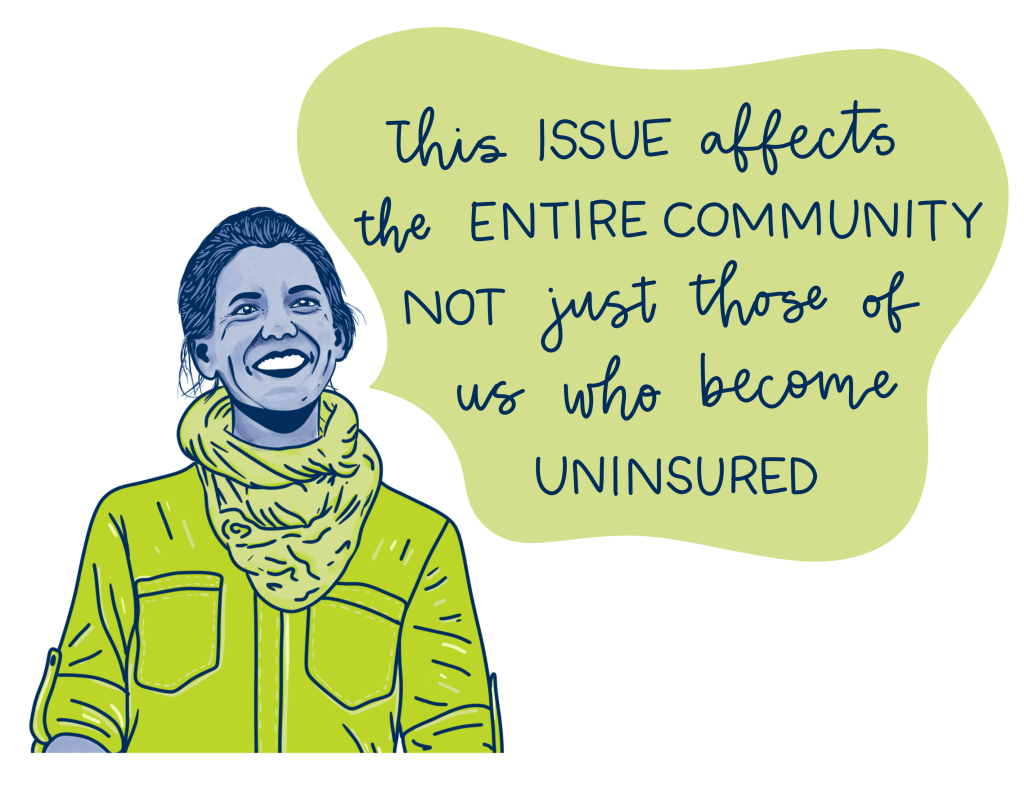
“This issue affects the entire community, not just those of us who become uninsured,” says Giroux, who prides herself on growing fresh, nutrient-dense food for her neighbors—a herculean task that requires being healthy. When folks delay or forgo medical care due to lack of affordable premiums, services for everyone are affected: Community clinics struggle to meet demand; rural hospitals face high rates of closure; and local health systems cut services and staff.
In short, the end of premium tax credits doesn’t just make insurance more expensive—it reshapes community health.
Illustration by Michelle Newman.
More Local Voices