A Local Food System in ACTION
How a community-built food hub expanded access to local produce—and what’s at risk without federal support.
Renee Giroux
MANAGER, NORTHWEST CONNECTICUT REGIONAL GOOD HUB
When the Northwest Connecticut Regional Food Hub entered the farm-to-school space seven years ago, the entire community reaped the benefits. Students increased their fruit and veggie consumption, schools saw meal participation rise, and local farmers’ income grew—thanks, in large part, to the Local Food for Schools Incentive Program (LFSIP), yet another casualty of steep cuts by the USDA in March 2025.

“These funds were a big driver in our ability to pay regional growers their fair-farmer pricing,” says Renee Giroux who—in addition to serving as manager of the Food Hub—owns and operates Earth’s Palate Farm in Warren. While the majority of her produce gets to the local community via CSA shares, the rest fills in the gaps at the Torrington-based nonprofit.
In 2023, the NWCT Food Hub used LFSIP funds to provide 45 schools in six districts statewide with Connecticut-grown produce for school lunch programs. More federal dollars, courtesy of the Local Food Purchasing Agreement (LFPA) program, allowed Giroux and colleagues to partner with 15 different food pantries throughout the northwest corner to feed underserved populations. In the absence of these vital funding streams, interruptions have become the norm.
“The cancellation of these programs has been devastating for local farmers,” says Giroux, whose perspective spans both sides of the supply chain. More than 40 regional food producers have seen a drop in guaranteed sales; food-access sites are resorting to big agriculture from California and Arizona; and vulnerable neighbors are losing access to nutrient-dense, local produce.
For Giroux, the shifting landscape has invited a pivot back to 2017 when the Food Hub was launched with zero federal dollars. “Our community provided the initial seed money for the Food Hub to blossom and bloom,” says Giroux, underscoring its core purpose: to support and expand local businesses, promote sustainable agriculture, and build a stronger local food system.
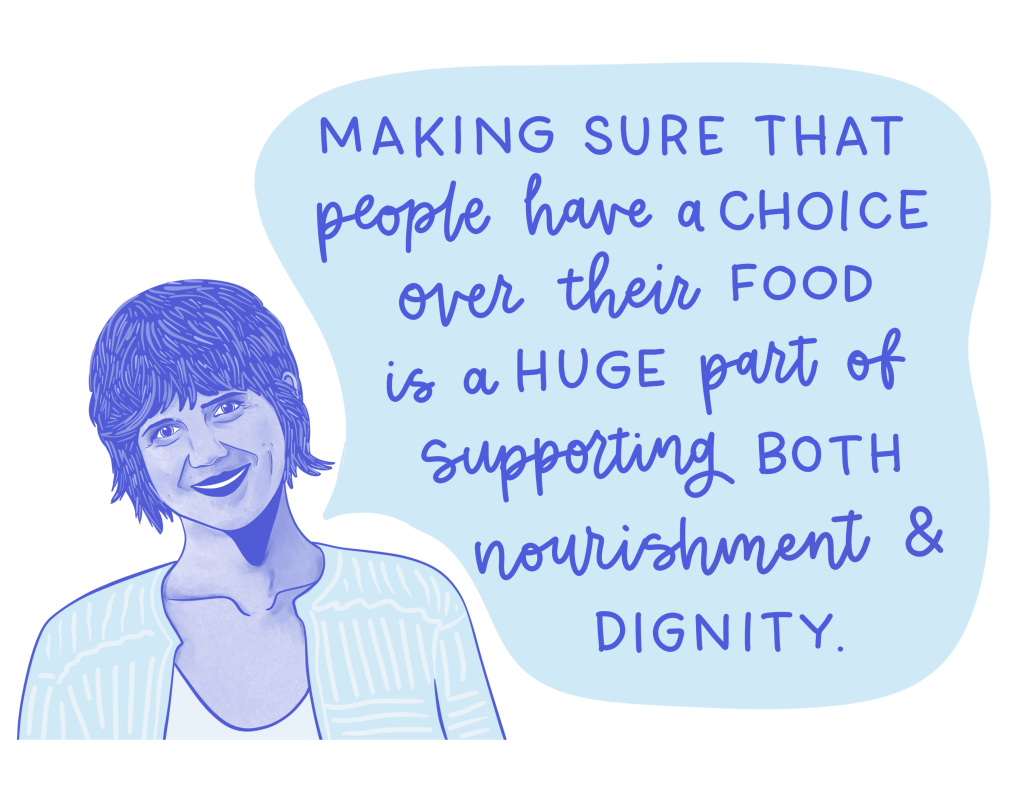
Illustration by Michelle Newman.
More Local Voices