Building Homes in Rural Connecticut
How scattered site financing and modular construction makes affordable home ownership possible in small towns
About the Litchfield County Center for Housing Opportunity
The Litchfield County Center for Housing Opportunity (LCCHO), an initiative of The Housing Collective, provides support and guidance to local housing organizations in Litchfield County to assist them through the process of creating housing options that are affordable in their town. In Litchfield County, almost all local housing organizations are volunteer led and have no staff. LCCHO provides day-to-day project management support, technical assistance on financing and grant applications, seed funding, and community engagement tools to these organizations. LCCHO also facilitates opportunities for collaboration and information sharing between these organizations.
With median sales prices of single family homes well above $700,000 in many Litchfield County towns and hundreds of households on waiting lists for the affordable rental homes that exist, LCCHO addresses the need for affordable owner and renter housing options by providing deep and ongoing support to the local efforts to create them. LCCHO currently supports 18 affordable housing organizations, has allocated $203,000 in pre-development seed funding for 8 projects, has helped local non-profits access over $15 million in financing resources, and has 231 housing units in the development pipeline in 12 Litchfield County towns.
The Rural Housing Funding Gap
Rural communities face a unique challenge: in order to be competitive for the traditional state and federal funding sources you need to have a relatively large project, especially for federal tax credits which is how much of the affordable housing in urban areas is financed. Small towns without public water and sewer infrastructure or with limited infrastructure, can’t accommodate these larger developments. Also, the parcels that are donated or sold at below market rates to the local non-profits in our region are often not large enough to support a large project or contain significant building constraints such as steep slopes or wetland areas. Not being able to accommodate larger developments can effectively lock non-profits in our region out of major funding streams.
By bringing together ten home sites across multiple towns into one coordinated project, LCCHO created the “volume” needed to access institutional financing, achieve economies of scale, attract a general contractor, and secure state grant funding for the gap between the affordable sales price and the cost to build these homes. The project also utilized modular construction – manufacturing home components in factory environments before on-site assembly – an effective method to speed up the timeline for construction while maintaining quality.
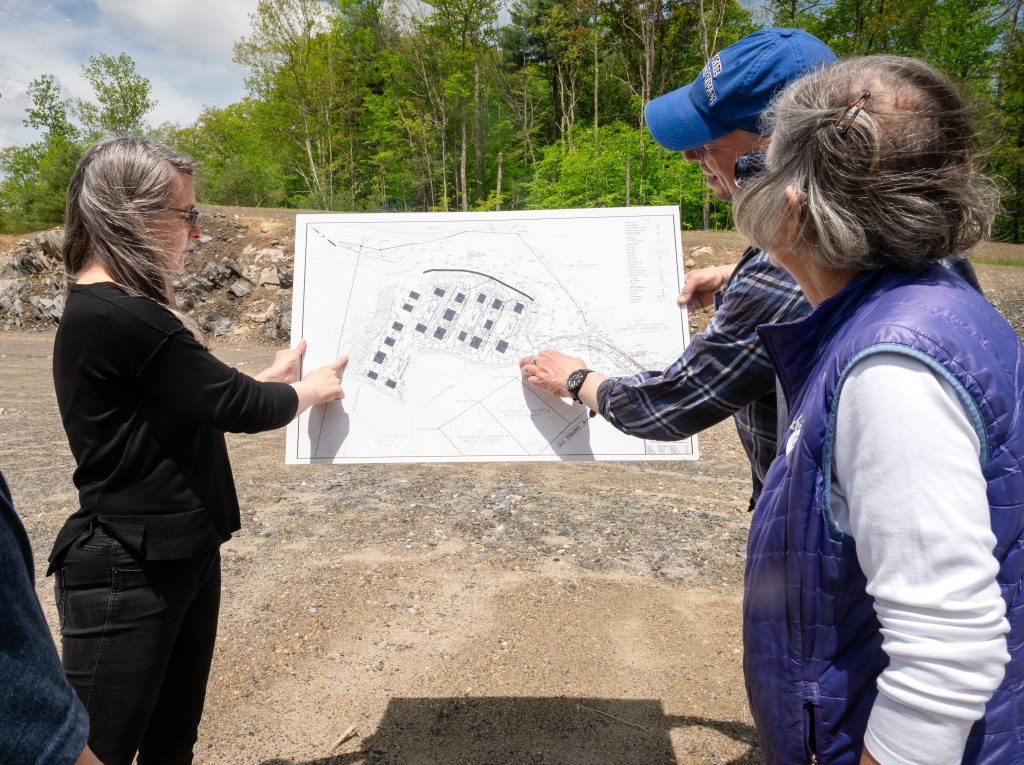
This short video highlights the collaborative approach of town-based, volunteer-led nonprofits, elected officials, and regional housing support while showcasing the innovative scattered site model in action:
Our Work with the Litchfield County Center for Housing Opportunity
Our partnership with LCCHO reflects our commitment to supporting local decision-making and strengthening community infrastructure – two core pillars of our theory of change. Since LCCHO’s establishment in 2021, we’ve provided multi-year general operating support to build the organization’s capacity and resilience. We’ve also funded pass-through grants that enabled towns and local nonprofits to pursue community engagement initiatives around housing in their communities.
LCCHO’s collaborative approach – working alongside local nonprofits to develop housing solutions tailored to each town’s needs and capacity – exemplifies the kind of community-driven work we aim to support. By strengthening LCCHO’s ability to guide local volunteer-driven housing organizations, we help ensure more aspects of our community work to improve the conditions required for health, well-being, and equity. Access to housing that is stable and affordable is foundational to all of these.